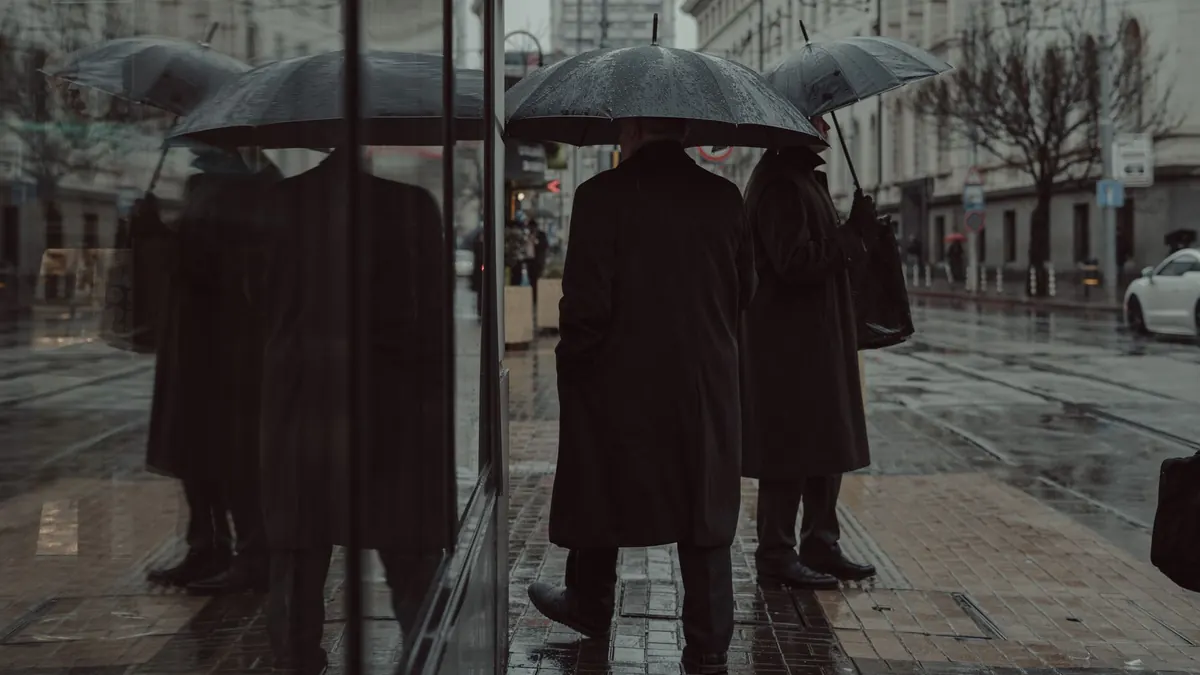
A child's umbrella lives a harder life than yours. It gets dropped on the pavement, wedged into a school bag, forced open one-handed while the other hand holds a lunchbox, and closed in a hurry by someone who isn't watching their fingers. The problems that show up are rarely dramatic. They are small design details that only reveal themselves on the third wet morning. Before you buy, work through these eight checks. In a shop it takes two minutes; online, it takes a careful read of the product photos and reviews.
1. Rounded Tips and Blunt Edges
Start at the very top. Plenty of umbrellas finish in a pointed metal spike. That is fine on an adult's model and a poor idea at a child's eye level. A kid walking at shoulder height, turning to answer a friend, is exactly the situation where a sharp ferrule meets a face.
Look for a rounded, rubberised or moulded plastic cap instead. Then run a thumb along the outer edge of the canopy. Every rib should end in a covered tip, and those covers should be fixed in place — crimped, glued or moulded — not simply pushed on. A cap that twists off easily becomes a small part on the floor, and what's left behind is a bare metal end.
2. Pinch-Free Opening and Closing
Automatic umbrellas appeal to children because pressing a button feels like a magic trick. The trade-off is a spring under tension releasing fast. On a small canopy held close to the body, that snap can catch a finger between the runner and the shaft.
If you go automatic, check that the button is firm enough that it won't fire in a backpack, and that the frame locks open securely rather than hovering. Manual umbrellas are slower, but your child controls the speed.
Where fingers actually get caught
- The runner — the collar that slides up and down the shaft
- The scissor joints where the stretchers meet the ribs
- The latch or clip that holds the umbrella closed
Open and close the umbrella yourself, slowly, five times. Watch for gaps that narrow like scissors as the frame moves. Better kids' umbrellas cover these points with rounded housings or plastic guards. If you can see bare metal joints pinching shut, keep looking.
3. Small Parts, Straps and Cords
If the umbrella is for a child under five, treat it the way you'd treat any other object with small pieces. Removable charms, beads on the strap, and caps that pull off all belong in the same category as toy parts that go in mouths.
Wrist straps deserve a second look. A long dangling cord can catch on climbing frames, gates or bus handrails. A short flat strap is a better choice than a loop that swings. If the umbrella you like has a long cord, cut it back or knot it short rather than leaving it loose.
4. Reflective Elements and Visibility
Most school runs happen in grey light or worse. Reflective trim earns its place where it will actually be seen: around the rim of the canopy, on the tips, and along the carrying strap. A single reflective logo printed in the middle of the canopy is mostly decoration.
Bright colours help too, and so does a canopy that doesn't block the view. When the umbrella is open, check that the rim sits at or above your child's shoulder line. An umbrella that droops to eye level turns a short walk to the school gate into a blindfolded one, and that matters most at kerbs.
5. Size, Weight and Grip
An oversized canopy is a common mistake. It catches wind, tips the child off balance, and forces them to lean sideways to keep it upright. Undersized is no better — rain simply runs off the edges onto shoulders and bag. Match the canopy to the child's height and build, and take the umbrella off the shelf so they can hold it up themselves.
Weight matters more than you'd expect. A child needs to carry it steady for ten or fifteen minutes, sometimes with a backpack on. Handles should be chunky enough for small hands, with a textured or rubberised grip. A slim adult handle looks tidy and slips out of a wet palm.
6. Frame, Fabric and Hardware
Ribs made from fibreglass or aluminium tend to flex and spring back. Thin steel ribs bend, and once bent they stay bent and start to rust at the fold. If you shop in person, open the umbrella and look along the ribs for kinks or uneven tension.
A vented canopy — one with a gap or mesh panel near the top — lets wind pass through instead of turning the umbrella inside out. Fabric should feel supple; stiff plastic-coated material cracks at the folds within a season. Finally, check the stitching where the ribs push into their pockets. That's the seam that fails first.
7. The Two-Minute Check Before You Pay
- Open and close it five times and watch for pinching gaps.
- Press every rib tip with your thumb — none should move.
- Look at the top ferrule. Rounded, not pointed.
- Tilt the canopy and check that the rim clears your child's eyeline.
- Ask your child to hold it up for a slow count of thirty.
- Grip the handle with wet hands and shake gently.
- Check the strap length and remove anything dangling.
- Look for a label confirming it meets the toy safety rules where you live, if it's sold as a child's product.
Practice Before the First Rainy Morning
Buy the umbrella a week before you need it, then let your child open and close it on the kitchen floor a few times. Show them where hands belong — on the handle, never on the joints — and let them feel the frame move slowly. It's also worth agreeing on two rules: no opening it indoors, and no poking anyone with the tips, even in play.
Store it open to dry rather than folded wet in a bag, and check the rib tips and joints every few months. Most of the umbrellas that fail do so at a hinge or a cap, and both are easy to spot once you know where to look. Choose a plain, well-built umbrella over a character-covered one with sharp corners, and your child gets something they can carry confidently through a wet winter.
Photo: Vika Glitter / Pexels